Chess
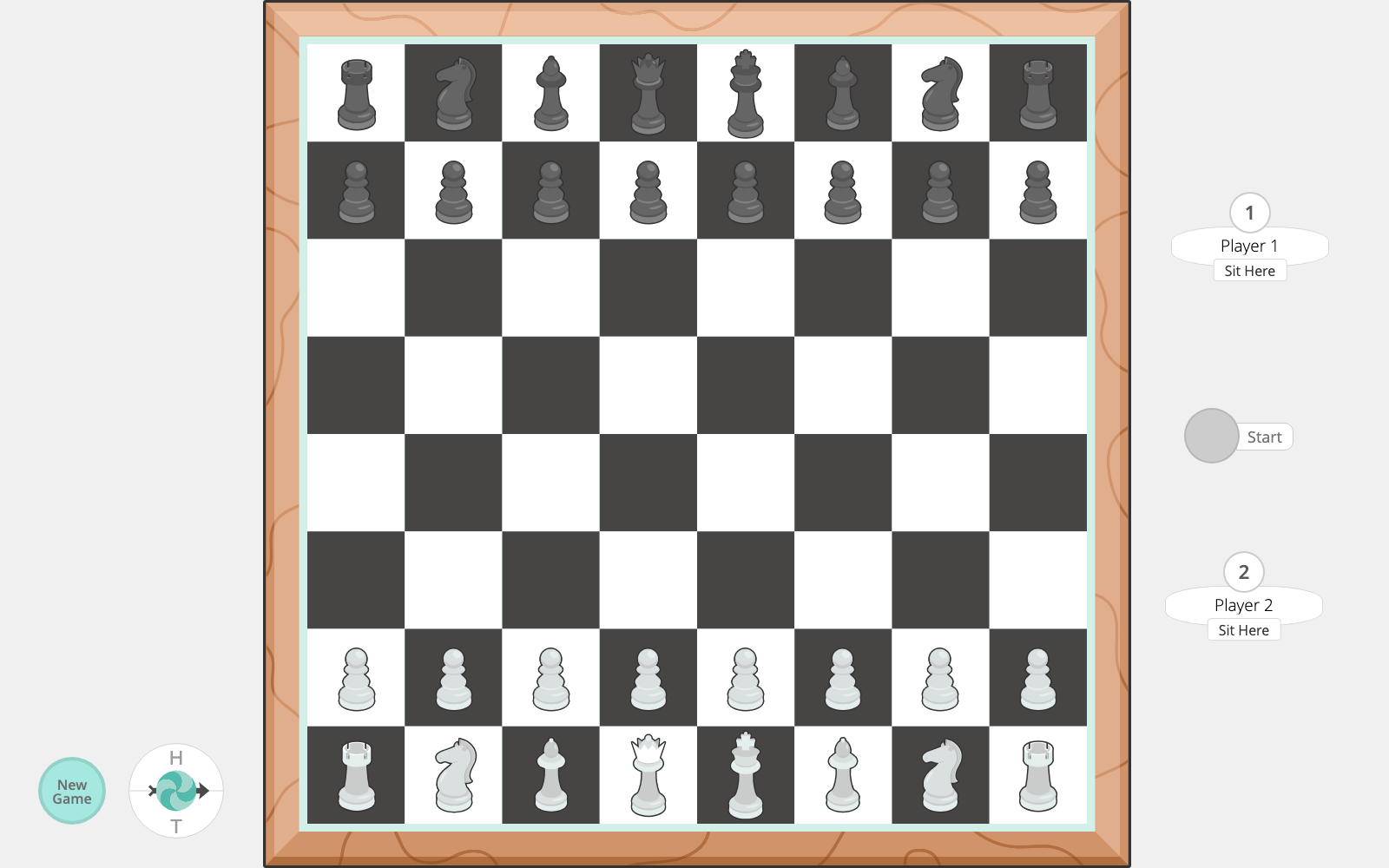
Its a battle of the minds in the ultimate abstract 2 player strategy classic game of Chess!

How to Play Chess
These are the basic rules for how to play Chess, but there are many resources online for strategy tips!
Objective
In Chess, the goal is to capture your opponent's king through the movements of your other pieces.
Set-up
For PlayingCards.io, the pieces are already set up for you to pick a color and play. If you'd like to setup for a physical game, reference the setup in a Chess room on PlayingCards.io.
Playing the Game
- The white player takes the first turn. Players alternate turns, moving one piece at a time.
How Pieces Move
King: Move one square in any direction (orthogonal or diagonal)
Queen: Move any number of squares in any one direction (orthogonal or diagonal)
Bishop: Move diagonally any number of squares
Knight: Move in an L pattern (2 squares orthogonally then 1 square in a perpendicular direction to the first move or vice versa - 1 square orthogonally then 2 squares in a perpendicular direction to the first move). The Knight is the only piece that can move over other pieces
Rook: Move orthogonally any number of squares
Pawn: Move one square forward or 1-2 squares forward if it is the pawn's first move. Pawns move diagonally only when they are capturing a piece.
- When a piece lands into a space occupied by the opponent's piece, the opponent's piece is captured and removed from the board.
- Pawns cannot capture pieces in front of them, instead they move diagonally one space to capture an opponent's piece (diagonal movements for pawns only occur when capturing).
- When a player moves a piece in such a way that their opponent's king would be vulnerable to capture on the next move, that player announces "check".
- When check is announced, the player whose king is vulnerable must spend their move to either move their king, move a piece to block the capture, or capture the piece that check was announced because of.
- When a move is made that would make the opponent's king vulnerable to capture and there is not legal move to avoid capture, "checkmate" is announced at which point the player who announced "checkmate" would win.
- A king cannot make a move that would put it into "check". If the king cannot make a move that would not put it into check, the game is a draw.
- If a pawn makes it to the far side of the board, it may be promoted to any piece (taking from pieces that were previously captured).
- "Castling" is a move that occurs between the king and the rook. When there are no pieces between a player's king and rook and neither piece have taken a move yet this game, the king can move 2 squares towards the rook and the rook is placed on the opposite side of the king. Castling cannot move the king out of check, into check or through check.
- "En passant" is a special capture move that may be made by a pawn after the opposing pawn took their first move by moving 2 squares. If the pawn would have been able to capture the opposing pawn (that moved 2 squares) had the opposing pawn only moved 1 square for its first move, the pawn can capture the opposing pawn by moving diagonally as it would have for a normal capture, into the square that would have been occupied by the opposing pawn had the opposing pawn started its movement with a 1 square forward move. En passant must be done immediately after an opposing pawn's starting 2 square move.
Winning
When a player forces their opponent into checkmate, they win!
This game was developed using PlayingCards.io virtual tabletop, an online play space where you can play tabletop and card games directly in your browser, multiplayer with your friends.
PlayingCards.io makes it easy to create, share, and play games.